This class implements a Gaussian Process (GP) regression model for non-parametric Bayesian regression. More...
#include <gp.h>
Public Member Functions | |
| GaussianProcess () | |
| ~GaussianProcess ()=default | |
| GaussianProcess (const std::shared_ptr< covariance::Covariance > &kernel, const std::shared_ptr< mean::Mean > &mean, Eigen::Ref< const Eigen::VectorXd > params, double nugget=1e-8) | |
| GaussianProcess (const GaussianProcess &other) | |
| GaussianProcess & | operator= (const GaussianProcess &other) |
| GaussianProcess (GaussianProcess &&other) noexcept | |
| GaussianProcess & | operator= (GaussianProcess &&other) noexcept |
| void | set (const std::shared_ptr< covariance::Covariance > &kernel, const std::shared_ptr< mean::Mean > &mean, Eigen::Ref< const Eigen::VectorXd > params, double nugget=1e-8) |
| void | condition (const Eigen::Ref< const Eigen::MatrixXd > &xObs, const Eigen::Ref< const Eigen::VectorXd > &yObs, bool copyData=true, bool normalizeY=false) |
| Condition the GP on a set of observations (allow predictive posterior computation) | |
| void | fit (const Eigen::Ref< const Eigen::MatrixXd > &xObs, const Eigen::Ref< const Eigen::VectorXd > &yObs, const Eigen::Ref< const Eigen::VectorXd > &lb, const Eigen::Ref< const Eigen::VectorXd > &ub, const method &method, const nlopt::algorithm &alg, const double &tol_rel, bool copyData=true, bool normalizeY=false, const std::shared_ptr< cmp::prior::Prior > &prior=cmp::prior::Uniform::make(), const std::vector< bool > &logScale={}) |
| Fit the Gaussian Process to the observations. | |
| Eigen::VectorXd | getParameters () const |
| Get the hyperparameters of the Gaussian Process. | |
| std::shared_ptr< cmp::mean::Mean > | getMean () const |
| Gets the shared pointer to the GP prior mean function. | |
| std::shared_ptr< cmp::covariance::Covariance > | getKernel () const |
| Gets the shared pointer to the GP covariance kernel. | |
| double | getNugget () const |
| Gets the observation noise variance (nugget). | |
| Eigen::MatrixXd | covariance (Eigen::Ref< const Eigen::VectorXd > par) const |
| Evaluates the covariance matrix of the Kernel. | |
| Eigen::MatrixXd | covarianceGradient (Eigen::Ref< const Eigen::VectorXd > par, const int &i) const |
| Eigen::MatrixXd | covarianceHessian (Eigen::Ref< const Eigen::VectorXd > par, const size_t &i, const size_t &j) const |
| const Eigen::LDLT< Eigen::MatrixXd > & | getCovDecomposition () const |
| const Eigen::VectorXd & | getAlpha () const |
| const Eigen::VectorXd & | getDiagCovInverse () const |
| const Eigen::VectorXd & | getResidualVector () const |
| const Eigen::Ref< const Eigen::MatrixXd > & | getXObs () const |
| const Eigen::Ref< const Eigen::VectorXd > & | getYObs () const |
| size_t | nObs () const |
| Returns the number of training observations. | |
| Eigen::VectorXd | priorMean (Eigen::Ref< const Eigen::VectorXd > par) const |
| Evaluates the mean on the observations. | |
| Eigen::VectorXd | priorMeanGradient (Eigen::Ref< const Eigen::VectorXd > par, const int &i) const |
| Evaluate the gradient of the mean function. | |
| Eigen::VectorXd | residual (Eigen::Ref< const Eigen::VectorXd > par) const |
| Evaluate the difference between the observation and the mean function. | |
| std::pair< double, double > | predict (const Eigen::Ref< const Eigen::VectorXd > &x, type predictionType=type::POSTERIOR) const |
| Compute the predictive mean and variance at a new point. | |
| double | predictMean (const Eigen::Ref< const Eigen::VectorXd > &x, type predictionType=type::POSTERIOR) const |
| Compute the predictive mean at a new point. | |
| std::pair< Eigen::VectorXd, Eigen::MatrixXd > | predictMultiple (const Eigen::Ref< const Eigen::MatrixXd > &x_pts, type predictionType=type::POSTERIOR) const |
| Compute the predictive variance at a new set of points. | |
| Eigen::VectorXd | predictMeanMultiple (const Eigen::Ref< const Eigen::MatrixXd > &x_pts, type predictionType=type::POSTERIOR) const |
| Compute the predictive mean at a new set of points. | |
| std::pair< double, double > | predictLOO (const size_t &i) const |
| Compute the leave-one-out predictive mean and variance at the i-th observation point. | |
| double | logLikelihood () const |
| Compute the log-likelihood of the observations given the hyperparameters. | |
| double | logLikelihoodLOO (const size_t &i) const |
| Compute the leave-one-out log-likelihood of the observations given the hyperparameters. | |
| Eigen::MatrixXd | expectedVarianceImprovement (const Eigen::Ref< const Eigen::MatrixXd > &x_pts, const Eigen::Ref< const Eigen::MatrixXd > &x_pending, double nu) const |
| double | objectiveFunction (const Eigen::Ref< const Eigen::VectorXd > &x, Eigen::Ref< Eigen::VectorXd > grad, const std::shared_ptr< cmp::prior::Prior > &prior) |
| double | objectiveFunctionLOO (const Eigen::Ref< const Eigen::VectorXd > &x, Eigen::Ref< Eigen::VectorXd > grad, const std::shared_ptr< cmp::prior::Prior > &prior) |
| double | objectiveFunctionLOOMSE (const Eigen::Ref< const Eigen::VectorXd > &x, Eigen::Ref< Eigen::VectorXd > grad, const std::shared_ptr< cmp::prior::Prior > &prior) |
Private Member Functions | |
| void | compute (const Eigen::Ref< const Eigen::VectorXd > &par) |
Private Attributes | |
| Eigen::VectorXd | par_ |
| Model hyperparameters. | |
| std::shared_ptr< covariance::Covariance > | pKernel_ |
| Covariance kernel function. | |
| std::shared_ptr< mean::Mean > | pMean_ |
| Prior mean function. | |
| double | nugget_ |
| Observation noise variance (nugget). | |
| std::optional< Eigen::MatrixXd > | xObs_ |
| Owning storage for training input matrix. | |
| std::optional< Eigen::VectorXd > | yObs_ |
| Owning storage for training target vector. | |
| std::optional< Eigen::Ref< const Eigen::MatrixXd > > | pXObs_ |
| Reference wrapper to training input matrix. | |
| std::optional< Eigen::Ref< const Eigen::VectorXd > > | pYObs_ |
| Reference wrapper to training target vector. | |
| Eigen::LDLT< Eigen::MatrixXd > | covDecomposition_ |
| LDLT decomposition of the training covariance matrix. | |
| Eigen::VectorXd | alpha_ |
| GP weights vector: alpha = (K + s^2 I)^-1 (y - m). | |
| Eigen::VectorXd | diagCovInverse_ |
| Diagonal elements of the inverse covariance matrix. | |
| Eigen::VectorXd | residual_ |
| Residuals of the mean function: y - m(x). | |
| bool | normalizeY_ = false |
| Flag indicating whether target normalization is active. | |
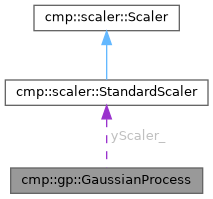
| cmp::scaler::StandardScaler | yScaler_ |
| Scaler used to normalize the target vector. | |
Detailed Description
This class implements a Gaussian Process (GP) regression model for non-parametric Bayesian regression.
Mathematical Foundations
A Gaussian Process is a collection of random variables, any finite number of which have a joint Gaussian distribution. It is completely specified by its mean function \(m(\mathbf{x})\) and covariance (kernel) function \(k(\mathbf{x}, \mathbf{x}')\):
\[ f(\mathbf{x}) \sim \mathcal{GP}\left(m(\mathbf{x}), k(\mathbf{x}, \mathbf{x}')\right) \]
Given a training dataset \(\mathcal{D} = \{(\mathbf{x}_i, y_i)\}_{i=1}^N\) where \(\mathbf{X} \in \mathbb{R}^{N \times D}\) and \(\mathbf{y} \in \mathbb{R}^N\), the joint distribution of the training outputs and the predictive function value \(f(\mathbf{x}_*)\) at a test point \(\mathbf{x}_*\) is:
\[ \begin{bmatrix} \mathbf{y} \\ f(\mathbf{x}_*) \end{bmatrix} \sim \mathcal{N}\left( \begin{bmatrix} \mathbf{m}(\mathbf{X}) \\ m(\mathbf{x}_*) \end{bmatrix}, \begin{bmatrix} \mathbf{K}(\mathbf{X}, \mathbf{X}) + \sigma_n^2 \mathbf{I} & \mathbf{k}(\mathbf{X}, \mathbf{x}_*) \\ \mathbf{k}(\mathbf{x}_*, \mathbf{X}) & k(\mathbf{x}_*, \mathbf{x}_*) \end{bmatrix} \right) \]
where \(\sigma_n^2\) is the nugget (representing the observation noise variance).
The conditional posterior distribution at the test point \(\mathbf{x}_*\) is given by:
\[ f(\mathbf{x}_*) | \mathbf{X}, \mathbf{y}, \mathbf{x}_* \sim \mathcal{N}(\mu_*, \sigma_*^2) \]
where the posterior mean \(\mu_*\) and variance \(\sigma_*^2\) are calculated as:
\[ \mu_* = m(\mathbf{x}_*) + \mathbf{k}(\mathbf{x}_*, \mathbf{X}) \left[ \mathbf{K}(\mathbf{X}, \mathbf{X}) + \sigma_n^2 \mathbf{I} \right]^{-1} (\mathbf{y} - \mathbf{m}(\mathbf{X})) \]
\[ \sigma_*^2 = k(\mathbf{x}_*, \mathbf{x}_*) - \mathbf{k}(\mathbf{x}_*, \mathbf{X}) \left[ \mathbf{K}(\mathbf{X}, \mathbf{X}) + \sigma_n^2 \mathbf{I} \right]^{-1} \mathbf{k}(\mathbf{X}, \mathbf{x}_*) \]
Implementation Algorithms
- LDLT Decomposition: Directly inverting \(\mathbf{K}_y = \mathbf{K}(\mathbf{X}, \mathbf{X}) + \sigma_n^2 \mathbf{I}\) is numerically unstable and computationally expensive ( \(O(N^3)\)). We construct \(\mathbf{K}_y\) and compute its LDLT decomposition:
\[ \mathbf{K}_y = \mathbf{L} \mathbf{D} \mathbf{L}^T \]
- Backsubstitution: We precompute the weight vector \(\boldsymbol{\alpha}\) by solving:
\[ \mathbf{L} \mathbf{D} \mathbf{L}^T \boldsymbol{\alpha} = \mathbf{y} - \mathbf{m}(\mathbf{X}) \]
The predictive posterior mean is then efficiently evaluated as:\[ \mu_* = m(\mathbf{x}_*) + \mathbf{k}(\mathbf{x}_*, \mathbf{X}) \boldsymbol{\alpha} \]
- Hyperparameter Optimization: The hyperparameters \(\boldsymbol{\theta}\) of the covariance and mean functions are optimized by maximizing the marginal log-likelihood:
\[ \log p(\mathbf{y} | \mathbf{X}, \boldsymbol{\theta}) = -\frac{1}{2} (\mathbf{y} - \mathbf{m}(\mathbf{X}))^T \mathbf{K}_y^{-1} (\mathbf{y} - \mathbf{m}(\mathbf{X})) - \frac{1}{2} \log |\mathbf{K}_y| - \frac{N}{2} \log (2\pi) \]
using gradient-free (e.g., Subplex) or gradient-based NLopt algorithms.
Constraints & Invariants
- **Nugget ( \(\sigma_n^2\))**: Must be strictly positive ( \(\ge 10^{-12}\), default \(10^{-8}\)) to ensure the covariance matrix remains strictly positive-definite.
- Training Inputs: Pre-conditions require that the dataset is non-empty ( \(N \ge 1\)).
- Hyperparameter bounds: Must satisfy the user-specified bounds \(\mathbf{lb} \le \boldsymbol{\theta} \le \mathbf{ub}\).
Constructor & Destructor Documentation
◆ GaussianProcess() [1/4]
| cmp::gp::GaussianProcess::GaussianProcess | ( | ) |
◆ ~GaussianProcess()
|
default |
◆ GaussianProcess() [2/4]
| cmp::gp::GaussianProcess::GaussianProcess | ( | const std::shared_ptr< covariance::Covariance > & | kernel, |
| const std::shared_ptr< mean::Mean > & | mean, | ||
| Eigen::Ref< const Eigen::VectorXd > | params, | ||
| double | nugget = 1e-8 |
||
| ) |
◆ GaussianProcess() [3/4]
| cmp::gp::GaussianProcess::GaussianProcess | ( | const GaussianProcess & | other | ) |
◆ GaussianProcess() [4/4]
|
noexcept |
Member Function Documentation
◆ compute()
◆ condition()
| void cmp::gp::GaussianProcess::condition | ( | const Eigen::Ref< const Eigen::MatrixXd > & | xObs, |
| const Eigen::Ref< const Eigen::VectorXd > & | yObs, | ||
| bool | copyData = true, |
||
| bool | normalizeY = false |
||
| ) |
Condition the GP on a set of observations (allow predictive posterior computation)
- Parameters
-
xObs The observation points yObs The observation values copyData Decide whether or not to make a deep copy of the data normalizeY Whether to normalize the observation values
- Note
- if copyData is false, and normalizeY is true the function will throw an exception, since it cannot normalize the data without owning it.
◆ covariance()
| Eigen::MatrixXd GaussianProcess::covariance | ( | Eigen::Ref< const Eigen::VectorXd > | par | ) | const |
Evaluates the covariance matrix of the Kernel.
- FUNCTIONS FOR THE KERNEL
- Parameters
-
par The vector of hyperparameters
- Returns
- a matrix containing the evaluation of the Kernel on the observation points
◆ covarianceGradient()
| Eigen::MatrixXd GaussianProcess::covarianceGradient | ( | Eigen::Ref< const Eigen::VectorXd > | par, |
| const int & | i | ||
| ) | const |
Evaluate the i-th component of the gradient of the covariance matrix.
- Parameters
-
par The vector of hyperparameters i The component of the gradient required
◆ covarianceHessian()
| Eigen::MatrixXd GaussianProcess::covarianceHessian | ( | Eigen::Ref< const Eigen::VectorXd > | par, |
| const size_t & | i, | ||
| const size_t & | j | ||
| ) | const |
Evaluate the ij component of the hessian of the covariance matrix.
- Parameters
-
par The vector of hyperparameters i row of the hessian matrix j colum of the hessian matrix
◆ expectedVarianceImprovement()
| Eigen::MatrixXd GaussianProcess::expectedVarianceImprovement | ( | const Eigen::Ref< const Eigen::MatrixXd > & | x_pts, |
| const Eigen::Ref< const Eigen::MatrixXd > & | x_pending, | ||
| double | nu | ||
| ) | const |
- FUNCTIONS FOR THE EXPECTED VARIANCE IMPROVEMENT
◆ fit()
| void GaussianProcess::fit | ( | const Eigen::Ref< const Eigen::MatrixXd > & | xObs, |
| const Eigen::Ref< const Eigen::VectorXd > & | yObs, | ||
| const Eigen::Ref< const Eigen::VectorXd > & | lb, | ||
| const Eigen::Ref< const Eigen::VectorXd > & | ub, | ||
| const method & | method, | ||
| const nlopt::algorithm & | alg, | ||
| const double & | tol_rel, | ||
| bool | copyData = true, |
||
| bool | normalizeY = false, |
||
| const std::shared_ptr< cmp::prior::Prior > & | prior = cmp::prior::Uniform::make(), |
||
| const std::vector< bool > & | logScale = {} |
||
| ) |
Fit the Gaussian Process to the observations.
- Parameters
-
xObs the observation points yObs the observation values lb the lower bound for the hyperparameters ub the upper bound for the hyperparameters method the method to be used for the optimization alg the algorithm to be used for the optimization tol_rel the relative tolerance for the optimization copyData whether to copy the observation data internally (default is true) normalizeY whether to normalize the observation values (default is false) prior the prior distribution for the hyperparameters (default is uniform prior) logScale a vector indicating which hyperparameters should be optimized in log scale (default is all false)
- FIT THE GP
◆ getAlpha()
|
inline |
◆ getCovDecomposition()
|
inline |
◆ getDiagCovInverse()
|
inline |
◆ getKernel()
|
inline |
Gets the shared pointer to the GP covariance kernel.
- Returns
- Shared pointer to the Covariance object.
◆ getMean()
|
inline |
Gets the shared pointer to the GP prior mean function.
- Returns
- Shared pointer to the Mean object.
◆ getNugget()
|
inline |
Gets the observation noise variance (nugget).
- Returns
- Nugget value.
◆ getParameters()
|
inline |
Get the hyperparameters of the Gaussian Process.
- Returns
- the value of the hyperparameters
◆ getResidualVector()
|
inline |
◆ getXObs()
◆ getYObs()
◆ logLikelihood()
| double GaussianProcess::logLikelihood | ( | ) | const |
Compute the log-likelihood of the observations given the hyperparameters.
- LOG LIKELIHOOD FUNCTIONS
- Returns
- The value of the log-likelihood
- Exceptions
-
runtime_error if the GP is not conditioned
◆ logLikelihoodLOO()
Compute the leave-one-out log-likelihood of the observations given the hyperparameters.
- Returns
- The value of the leave-one-out log-likelihood
- Exceptions
-
runtime_error if the GP is not conditioned or out_of_range if i is out of range [0, nObs_)
◆ nObs()
|
inline |
Returns the number of training observations.
- Returns
- Number of training data rows.
◆ objectiveFunction()
| double GaussianProcess::objectiveFunction | ( | const Eigen::Ref< const Eigen::VectorXd > & | x, |
| Eigen::Ref< Eigen::VectorXd > | grad, | ||
| const std::shared_ptr< cmp::prior::Prior > & | prior | ||
| ) |
- * OBJECTIVE FUNCTIONS FOR THE OPTIMIZATION
◆ objectiveFunctionLOO()
| double GaussianProcess::objectiveFunctionLOO | ( | const Eigen::Ref< const Eigen::VectorXd > & | x, |
| Eigen::Ref< Eigen::VectorXd > | grad, | ||
| const std::shared_ptr< cmp::prior::Prior > & | prior | ||
| ) |
◆ objectiveFunctionLOOMSE()
| double GaussianProcess::objectiveFunctionLOOMSE | ( | const Eigen::Ref< const Eigen::VectorXd > & | x, |
| Eigen::Ref< Eigen::VectorXd > | grad, | ||
| const std::shared_ptr< cmp::prior::Prior > & | prior | ||
| ) |
◆ operator=() [1/2]
◆ operator=() [2/2]
|
noexcept |
◆ predict()
| std::pair< double, double > GaussianProcess::predict | ( | const Eigen::Ref< const Eigen::VectorXd > & | x, |
| type | predictionType = type::POSTERIOR |
||
| ) | const |
Compute the predictive mean and variance at a new point.
FUNCTIONS FOR THE PREDICTIVE DISTRIBUTION
- Parameters
-
x The new prediction point predictionType The type of prediction (prior or posterior)
- Returns
- A pair containing the mean and variance of the prediction
- MAKING PREDICTIONS
◆ predictLOO()
Compute the leave-one-out predictive mean and variance at the i-th observation point.
- Parameters
-
i The index of the observation point
- Returns
- A pair containing the mean and variance of the leave-one-out prediction
- Exceptions
-
std::out_of_range if i is out of range [0, nObs_) and runtime error if the GP is not conditioned
◆ predictMean()
| double GaussianProcess::predictMean | ( | const Eigen::Ref< const Eigen::VectorXd > & | x, |
| type | predictionType = type::POSTERIOR |
||
| ) | const |
Compute the predictive mean at a new point.
- Note
- The predictive mean can be computed in O(n) time for the posterior and O(1) time for the prior. Hence it is better to use this function if only the mean is required.
- Parameters
-
x The new prediction point predictionType The type of prediction (prior or posterior)
- Returns
- The predictive mean
◆ predictMeanMultiple()
| Eigen::VectorXd cmp::gp::GaussianProcess::predictMeanMultiple | ( | const Eigen::Ref< const Eigen::MatrixXd > & | x_pts, |
| type | predictionType = type::POSTERIOR |
||
| ) | const |
Compute the predictive mean at a new set of points.
- Parameters
-
x_pts The new prediction points predictionType The type of prediction (prior or posterior)
- Returns
- The predictive mean
- Note
- The predictive mean can be computed in O(n*m) time for the posterior and O(m) time for the prior, where n is the number of observations and m is the number of prediction points. Hence it is better to use this function if only the mean is required.
◆ predictMultiple()
| std::pair< Eigen::VectorXd, Eigen::MatrixXd > cmp::gp::GaussianProcess::predictMultiple | ( | const Eigen::Ref< const Eigen::MatrixXd > & | x_pts, |
| type | predictionType = type::POSTERIOR |
||
| ) | const |
Compute the predictive variance at a new set of points.
- Parameters
-
x_pts The new prediction points predictionType The type of prediction (prior or posterior)
- Returns
- A pair containing the mean and variance of the predictions
◆ priorMean()
| Eigen::VectorXd GaussianProcess::priorMean | ( | Eigen::Ref< const Eigen::VectorXd > | par | ) | const |
Evaluates the mean on the observations.
- FUNCTIONS FOR THE MEAN
- Parameters
-
par The vector of hyperparameters
- Returns
- The mean of the points.
◆ priorMeanGradient()
| Eigen::VectorXd GaussianProcess::priorMeanGradient | ( | Eigen::Ref< const Eigen::VectorXd > | par, |
| const int & | i | ||
| ) | const |
Evaluate the gradient of the mean function.
- Parameters
-
par The vector of hyperparameters i the index of the hyperparameter
- Returns
- a vector containing the computation of the gradient
◆ residual()
| Eigen::VectorXd GaussianProcess::residual | ( | Eigen::Ref< const Eigen::VectorXd > | par | ) | const |
Evaluate the difference between the observation and the mean function.
- Parameters
-
par The vector of hyperparameters
- Returns
- a vector containing the computation of the residual
◆ set()
| void cmp::gp::GaussianProcess::set | ( | const std::shared_ptr< covariance::Covariance > & | kernel, |
| const std::shared_ptr< mean::Mean > & | mean, | ||
| Eigen::Ref< const Eigen::VectorXd > | params, | ||
| double | nugget = 1e-8 |
||
| ) |
A GP is defined by a Kernel function, a mean function, a nugget and its hyperparameters.
- Parameters
-
kernel The Kernel function mean The mean function params The vector of hyperparameters nugget The nugget value (default is 1e-8)
- Note
- This function is used to set the Kernel and mean functions of the GP.
Member Data Documentation
◆ alpha_
|
private |
GP weights vector: alpha = (K + s^2 I)^-1 (y - m).
◆ covDecomposition_
|
private |
LDLT decomposition of the training covariance matrix.
◆ diagCovInverse_
|
private |
Diagonal elements of the inverse covariance matrix.
◆ normalizeY_
Flag indicating whether target normalization is active.
◆ nugget_
|
private |
Observation noise variance (nugget).
◆ par_
|
private |
Model hyperparameters.
◆ pKernel_
|
private |
Covariance kernel function.
◆ pMean_
|
private |
Prior mean function.
◆ pXObs_
|
private |
Reference wrapper to training input matrix.
◆ pYObs_
|
private |
Reference wrapper to training target vector.
◆ residual_
|
private |
Residuals of the mean function: y - m(x).
◆ xObs_
|
private |
Owning storage for training input matrix.
◆ yObs_
|
private |
Owning storage for training target vector.
◆ yScaler_
|
private |
Scaler used to normalize the target vector.
The documentation for this class was generated from the following files: